
Sustainable Slip Resistance
What is sustainable slip resistance?
Put simply, this is the level of slip resistance that can be reasonably expected to be sustained over the many years of a product being in service.
Isn’t a regular slip test enough?
Under standard slip resistance tests, many products score an unrepresentatively high result when brand new, straight out of the box.
Many factors, including deposits or grit on the tile left over from the manufacturing process, can influence the results of a slip test. In some cases, even small amounts of wear can drastically reduce the slip resistance of a tile. After the floor is installed and has undergone a routine post-construction clean, a product receiving a P5 result straight out of the box could test at P3 or lower.
Designers and specifiers need to determine whether the slip resistance test results supplied are likely to be sustained over time.
How to test for sustainable slip resistance
Slip test results can easily be supplied to show the result when new as well as after Accelerated Wear Testing (AWT).
The same laboratories (CSIRO, Safe Environments and ATTAR) who perform the slip resistance tests, will also provide AWT testing on request. AWT testing, as the name implies, involves applying wear to the product’s surface, then re-testing the slip resistance.
The degree of wear applied is referred to by the number of cycles. Small amounts of wear like 50 and 100 cycles will easily identify items that show an unrepresentative result when brand new.
Results after a greater amount of wear cycles 500, 1,000 and 5,000 cycles indicate the products that provide the most sustainable slip resistance.
Metz provides AWT results at 5,000 cycles for our Sicodur® and MicroGRIP® finishes, the maximum number of cycles used.
How much sustainable slip resistance?
Despite the complexity of this issue, there is one driving factor that overwhelmingly characterises the risk of a slip incident occuring:
any floor receiving a pendulum test result lower than 30BPN will result in users slipping if it gets wet.
Many specifiers therefore treat 35BPN as the minimum safe pendulum test result they require for areas that are going to get wet. Remember, this result needs to be sustained throughout the life of the floor, not just on day one.
Keep it dry – or over 35BPN
Virtually all slips occur on a wet floor, but not all wet floors are slippery. Controlling the masses on a “slippery when wet” floor is costly, time consuming and presents an ongoing risk, forever, until the floor is replaced.
Floors in high traffic areas more likely to get wet, and it’s not just bad weather and accompanying water from umbrellas and raincoats that poses a risk. A spilled coffee or even food from nearby outlets is considered a wet floor. Adequately slip resistant tiles (over 35BPN) are a necessity on all floors that are even ‘occasionally’ wet.
Latest News
Transport Infrastructure Product Selection Guide: Tiles
Slip resistant tiles for transport hubs, airports, train stations & more
Key considerations for designers and specifiers
Level of service duty
Transport infrastructure projects are ...
Floor cleaning and risk management
Everywhere a sign
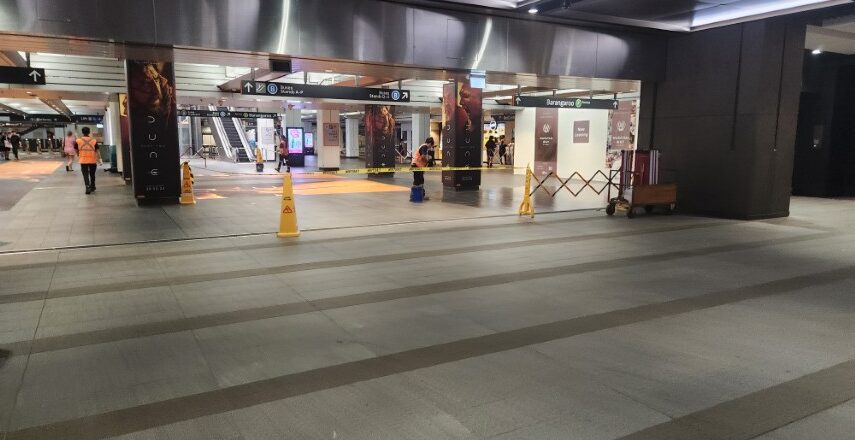
The adjacent image shows a cleaner working on a “slippery when wet” floor, with an area cordoned off and signage ...

Andrew (Boy) Charlton Pool Re-Tile and Restoration Project, Sydney CBD
Metz Project Services completed a re-tile & restoration project at iconic Sydney CBD landmark Andrew (Boy) Charlton Pool in 2025.
The extensive remediation ...